Complete your stack
- GLO (TB-500 + BPC-157 + Copper GHk Peptide Blend) $109.99
- Tirzepatide $109.99 Coming soon
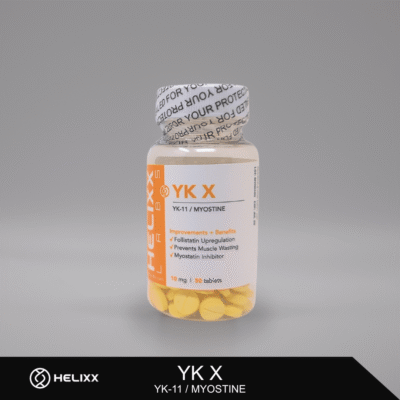
- YK11 - Myostine $109.99
MOTS-c
$99.99
MOTS-c is the exercise-mimetic mitochondrial peptide researchers reach for when the target is metabolism, AMPK signalling, and endurance. Premium MOTS-c Canada supply, third-party-tested and lab-ready.
Description
If your research program touches metabolism, insulin signalling, or endurance, MOTS-c is the mitochondrial-derived peptide worth keeping on the bench. Discovered in 2015 and often described as an “exercise mimetic,” MOTS-c activates AMPK, the master metabolic switch, to drive glucose uptake and fatty-acid oxidation in skeletal muscle. Helixx supplies lab-grade Canadian peptides to Canadian institutions and independent investigators, so sourcing high-purity MOTS-c Canada stock for your next study is fast, traceable, and painless.1
What Is MOTS-c?
MOTS-c (Mitochondrial ORF of the Twelve S rRNA type-c) is a 16-amino-acid peptide with the sequence MRWQEMGYIFYPRKLR. Unlike most peptides studied in the lab, it is not encoded in the nuclear genome at all. It sits inside the mitochondrial 12S ribosomal RNA gene, which puts it in a small class of mitochondrial-derived peptides. Since its identification in 2015 it has become a focal point for research into cellular energy balance, ageing, and metabolic stress. Because endogenous MOTS-c levels rise with physical activity, researchers often frame exogenous administration as a partial exercise mimetic. It is supplied strictly as a research chemical for laboratory and educational use only, and is not intended for human consumption.
How MOTS Works
The peptide’s central mechanism is activation of AMP-activated protein kinase (AMPK), the cell’s principal energy sensor. MOTS-c inhibits the folate cycle and its tethered de novo purine biosynthesis pathway, and that causes intracellular accumulation of AICAR, a potent endogenous AMPK activator. Once AMPK is engaged, MOTS-c enhances insulin-independent glucose uptake in skeletal muscle, its principal target organ, increases fatty-acid oxidation, and improves markers of insulin sensitivity in model systems. Under metabolic stress the peptide does more than signal at the membrane: it translocates to the nucleus in an AMPK-dependent manner, binding antioxidant-response-element (ARE) regions and interacting with stress transcription factors such as NRF2 (NFE2L2) to regulate a suite of antioxidant and metabolic genes.1 That two-part action, acute metabolic signalling plus adaptive transcriptional regulation, is exactly what makes MOTS-c such a useful probe for studying how cells respond to energetic demand.
What the Research Shows
- Nuclear gene regulation under stress. Metabolic stress triggers AMPK-dependent nuclear translocation of MOTS-c, where it engages antioxidant-response-element genes and interacts with NRF2 and other stress transcription factors to reprogram the cell’s metabolic and antioxidant output.1
- Exercise induction and physical capacity. Endogenous MOTS-c rose with exercise in human skeletal muscle (roughly five-fold) and in circulation (roughly 1.5-fold). In mice, systemic MOTS-c approximately doubled treadmill running capacity across all ages, and late-life intermittent dosing improved physical capacity, grip strength, gait, and overall healthspan measures.2
- Neuroprotection in a pain model. In a mouse spared-nerve-injury model, MOTS-c reduced neuropathic pain by suppressing spinal microglial activation and neuronal oxidative damage, an effect attributed to AMPK activation.3
Researchers frequently benchmark MOTS-c alongside other metabolic and endurance-focused compounds such as 5-Amino-1MQ, the exercise-mimetic Cardarine – GW-501516, and the fat-metabolism fragment AOD9604, or pair it in study designs with the recovery-oriented GLO (TB-500 + BPC-157 + Copper GHK Peptide Blend).
Chemical Properties

| Research Name | MOTS-c (Mitochondrial-Derived Peptide) |
| CAS Number | 147740-65-8 |
| Molecular Formula | C47H75N13O12 |
| Molecular Weight | 963.2 g/mol |
| Classification | 16-amino-acid mitochondrial-derived peptide; AMPK activator (sequence MRWQEMGYIFYPRKLR) |
Research Protocols & Handling
MOTS-c ships as a lyophilised powder for in-vitro and laboratory research and educational use only. It is not a drug, supplement, or food, and is not intended for human or veterinary use. Store the sealed lyophilised peptide at -20 °C, protected from light and moisture, where it stays stable long term. For laboratory work it is typically reconstituted with sterile bacteriostatic or sterile water. Once reconstituted, keep it refrigerated at 2-8 °C, minimise freeze-thaw cycles, and use it within a short working window to preserve peptide integrity. Handle it using standard laboratory practices, including appropriate personal protective equipment. All Helixx peptides Canada stock is intended for qualified researchers only.
Potential Side Effects & Safety
Nearly all efficacy and safety data for MOTS-c come from cell and rodent studies; human evidence is limited to small, short early-phase work. The observations below are either documented or drug-class-plausible, laid out so researchers can weigh the compound fairly.
- Injection-site reactions. The most consistently documented issue. Redness, irritation, and pain at the administration site have been reported, and a phase 1a/1b trial of the MOTS-c analog CB4211 was reportedly paused or limited in part because of persistent injection-site reactions.
- Nausea and transient GI upset. Mild, transient gastrointestinal effects have been reported, plausibly linked to AMPK activation and the acute metabolic shifts the peptide induces.
- Hypoglycemia risk. Because MOTS-c enhances insulin-independent glucose uptake, there is a class-plausible risk of low blood sugar, particularly where it is combined with insulin or other glucose-lowering agents.
- Anecdotal self-experimenter reports. Reports collected by USADA from self-experimenters describe increased heart rate or palpitations, insomnia, and fever. None of these have been confirmed in controlled trials, so treat them as unverified.
- Unknown long-term safety. No published human trial exceeds roughly 16 weeks. The limited short-term human data showed no hepatotoxicity or nephrotoxicity signal at the doses studied, but long-term safety remains unknown.
- Regulatory status. MOTS-c is a research chemical not approved for human use, and it is prohibited in sport under WADA/USADA rules.
Not approved for human consumption in Canada or elsewhere; research and educational use only.
Frequently Asked Questions
Is MOTS legal in Canada?
MOTS-c is not an approved drug, supplement, or food in Canada, and it is not authorised for human consumption. It can, however, be legally supplied to and possessed by researchers as a laboratory research chemical for in-vitro and educational use. Helixx sells MOTS-c Canada stock strictly on that basis. Keep in mind that MOTS-c is also prohibited in sport under WADA/USADA regulations.
What makes MOTS-c different from other research peptides?
Most peptides are encoded by the nuclear genome. MOTS-c is encoded within the mitochondrial 12S rRNA gene, which makes it a genuine mitochondrial-derived peptide. Its defining feature is AMPK activation driving glucose uptake and fatty-acid oxidation, which is why it is studied as a partial exercise mimetic rather than a growth or repair peptide like TB-500 or BPC-157.2
How is MOTS-c stored and reconstituted for research?
Store the lyophilised powder at -20 °C, protected from light and moisture. For laboratory use it is reconstituted with sterile bacteriostatic or sterile water, then kept at 2-8 °C with minimal freeze-thaw cycles. It is handled as a research reagent only, never for human or veterinary administration.
How strong is the human evidence for MOTS-c?
It is currently limited. The most compelling data come from cell and rodent studies, including work showing MOTS-c roughly doubled treadmill capacity in mice and regulates nuclear stress-response genes in cultured cells.1 Human evidence is confined to small, short early-phase studies, none exceeding roughly 16 weeks, so MOTS-c is best regarded as an investigational research compound rather than a validated intervention.
References
Peer-reviewed and authoritative sources cited above. Helixx supplies research materials for laboratory and educational use only; citations are provided for independent verification, not as medical guidance.
- Kim KH, Son JM, Benayoun BA, Lee C. The Mitochondrial-Encoded Peptide MOTS-c Translocates to the Nucleus to Regulate Nuclear Gene Expression in Response to Metabolic Stress. Cell Metabolism. 2018 Sep 4;28(3):516-524.e7. PMID: 29983246.
- Reynolds JC, Lai RW, Woodhead JST, et al. MOTS-c is an exercise-induced mitochondrial-encoded regulator of age-dependent physical decline and muscle homeostasis. Nature Communications. 2021 Jan 20;12(1):470. PMID: 33473109.
- Mitochondrial-Derived Peptide MOTS-c Ameliorates Spared Nerve Injury-Induced Neuropathic Pain in Mice by Inhibiting Microglia Activation and Neuronal Oxidative Damage in the Spinal Cord via the AMPK Pathway. 2023. PMID: 37285113.