Complete your stack
- GLO (TB-500 + BPC-157 + Copper GHk Peptide Blend) $109.99
- Tirzepatide $109.99 Coming soon
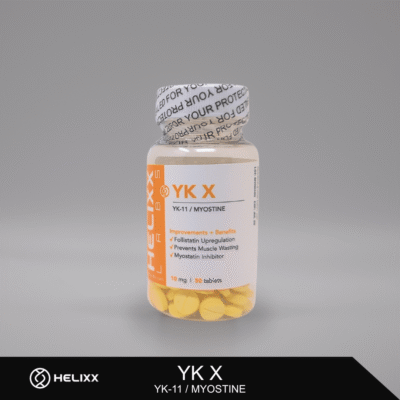
- YK11 - Myostine $109.99
BPC-157
$109.99
BPC-157 is one of the most-studied regenerative research peptides in Canada, a stable 15-amino-acid sequence prized in the lab for its pro-angiogenic, cytoprotective signalling. Premium purity, fast Canadian shipping. For laboratory and research use only.
Description
BPC-157 is the cornerstone of any serious regenerative peptide research program, and Helixx supplies it as premium, high-purity Canadian peptides shipped fast from within Canada. This synthetic 15-amino-acid sequence has become one of the most extensively investigated compounds in preclinical healing and cytoprotection science, with a rich body of animal and in-vitro literature exploring its pro-angiogenic and tissue-protective signalling.1 If your lab needs reliable, well-characterized BPC-157 Canada stock, this is the reference-grade material to work with.
What Is BPC-157?
BPC-157 (Body Protection Compound-157) is a synthetic peptide derived from a partial sequence of a protective protein originally isolated from human gastric juice. It is a stable pentadecapeptide: fifteen amino acids in the sequence Gly-Glu-Pro-Pro-Pro-Gly-Lys-Pro-Ala-Asp-Asp-Ala-Gly-Leu-Val. In the research setting it is studied for regenerative, protective, and anti-inflammatory properties across models of wound healing, gut protection, and musculoskeletal repair. It is worth stating plainly at the outset: BPC-157 is supplied strictly as a research chemical for laboratory and educational use only, and is not for human consumption.
How BPC Works
The principal proposed mechanism of BPC-157 is pro-angiogenic and cytoprotective signalling. In preclinical models it up-regulates vascular endothelial growth factor receptor-2 (VEGFR2) and drives the VEGFR2–Akt–eNOS axis, increasing endothelial nitric oxide synthase (eNOS) activity and nitric oxide (NO) production to promote new blood-vessel formation. In parallel, it modulates vasomotor tone through a Src–Caveolin-1–eNOS pathway, in which Src phosphorylates caveolin-1 to release eNOS for activation and raise NO output.2 BPC-157 is tightly linked to the NO system as a whole: it interacts with NO synthesis, counteracts the damaging actions of both excess NO and free radicals, and appears to participate in a homeostatic, NO-mediated cytoprotective response to injury.1 Downstream, the peptide has been reported to enhance fibroblast outgrowth, survival under oxidative stress, and migration, to promote collagen production, and to modulate growth-factor and growth-hormone-receptor expression. Keep in mind that essentially all of this mechanistic evidence is preclinical, drawn from in-vitro and rodent studies rather than controlled human data.
What the Research Shows
- Wound and tissue healing. A comprehensive review of preclinical evidence describes BPC-157 promoting the healing of skin wounds, burns, diabetic ulcers, and fistulas, acting as a cytoprotective agent with angiomodulatory effects and regulation of growth-factor and gene expression.3
- Nitric oxide and vascular protection. BPC-157 modulates vasomotor tone and activates eNOS via the Src–Caveolin-1 pathway, increasing NO production in support of its pro-angiogenic and vascular-protective profile.2
- NO-system homeostasis. Review-level work establishes BPC-157’s close relationship with the NO system, counteracting the harmful effects of both NO excess and free radicals while preserving protective, healing NO functions.1
- Early human safety signals. A pilot study in two healthy adults given intravenous BPC-157 reported it was well tolerated with no adverse effects and no measurable impact on cardiac, liver, kidney, thyroid, or blood-glucose biomarkers, though the authors stress much larger studies are needed.5
Researchers frequently compare and combine BPC-157 with other regenerative and recovery peptides. It is the central ingredient in our GLO (TB-500 + BPC-157 + Copper GHk Peptide Blend), is commonly studied alongside TB-500, and is often bracketed with growth-hormone-axis peptides such as CJC-1295 and Ipamorelin in comparative recovery protocols.
Chemical Properties

| Research Name | Body Protection Compound-157 (BPC-157) |
| CAS Number | 137525-51-0 |
| Molecular Formula | C62H98N16O22 |
| Molecular Weight | 1419.5 g/mol |
| Classification | Synthetic 15-amino-acid peptide (pentadecapeptide); sequence Gly-Glu-Pro-Pro-Pro-Gly-Lys-Pro-Ala-Asp-Asp-Ala-Gly-Leu-Val |
Research Protocols & Handling
This material is intended exclusively for in-vitro and laboratory research and educational purposes. It is not a drug, supplement, or food, and it is not for human or veterinary use. Lyophilized BPC-157 is typically stored sealed, cool, and away from light, with long-term storage at freezing temperatures to preserve peptide integrity. For research reconstitution it is generally dissolved in bacteriostatic or sterile water; reconstituted peptide is kept refrigerated and used within a limited working window to minimize degradation. Handlers should follow standard laboratory practice: appropriate personal protective equipment, clean technique, and accurate documentation. No dosing guidance for human administration is provided or implied.
Potential Side Effects & Safety
Honest disclosure matters. Human safety data for BPC-157 are very limited, restricted to small pilot and case reports, so long-term effects, appropriate dosing, and a complete side-effect profile are simply not established. The points below reflect both the sparse observed data and theoretical risks flagged in the literature.
- Unknown long-term profile. Only a handful of small human studies exist; safety, dosing, and long-term consequences remain unestablished, and the compound should be regarded as investigational pending larger, rigorous trials.4
- Theoretical tumour-growth risk. Because the peptide is pro-angiogenic, reviewers have repeatedly flagged the theoretical concern that pathologic angiogenesis could support tumour proliferation. This is unproven but taken seriously.4
- Excess nitric oxide and metabolite concerns. Mechanism-derived risks include effects of excess NO (possible impact on hemoglobin/enzyme function and anemia, altered drug metabolism, and speculative links to neurodegenerative disease) and the potential formation of toxic proline-related metabolites.4
- Injection-site reactions. Subcutaneous or intramuscular use in research contexts has been associated anecdotally with pain, redness, swelling, or fibrosis at the site.
- Immunogenicity. As a synthetic peptide, there is a potential for the immune system to recognize it as foreign.
- Gastrointestinal upset. Nausea and bloating have been reported anecdotally, particularly with oral use.
- Product-quality hazards. Unregulated “research-grade” material can carry contamination risks such as endotoxins and heavy metals, a manufacturing/quality hazard rather than an intrinsic property of the peptide, and one reason to source well-characterized stock.
For context, animal toxicology studies identified no minimum toxic or lethal dose and observed no teratogenic, genotoxic, anaphylactic, or local toxic effects; two-person IV pilot data likewise reported no adverse events.5 Regulatory posture, however, is cautious: BPC-157 is not FDA-approved, the FDA flagged it in September 2023 for significant safety risks and removed it from compounding, and it is prohibited in sport by WADA/USADA. Not approved for human consumption in Canada or elsewhere; research and educational use only.
Frequently Asked Questions
Is BPC legal in Canada?
BPC-157 is not an approved drug or health product in Canada and is not authorized for human consumption. It can, however, be supplied and possessed as a research chemical for laboratory and educational use only. Helixx sells BPC-157 Canada stock strictly on that basis: not for ingestion, injection into humans or animals, or any therapeutic purpose.
What is BPC-157 actually studied for?
In preclinical (animal and in-vitro) research it is investigated for regenerative, cytoprotective, and anti-inflammatory activity (wound healing, gut protection, and musculoskeletal repair), driven largely by its pro-angiogenic, NO-linked signalling.3 Human evidence remains minimal.
How does BPC-157 compare to TB-500?
Both are recovery-focused research peptides that researchers often study side by side, and they appear together in our GLO blend. BPC-157 is a short pentadecapeptide centred on angiogenesis and cytoprotection, whereas TB-500 is a thymosin-beta-4 fragment studied more for cell migration and actin regulation.
Is BPC-157 safe?
Its full safety profile is not established. Small human pilot data have reported no adverse effects,5 but reviewers still flag theoretical risks (including tumour-supporting angiogenesis and excess-NO effects) and conclude it should remain investigational.4 It is provided for research use only, never for human consumption.
References
Peer-reviewed and authoritative sources cited above. Helixx supplies research materials for laboratory and educational use only; citations are provided for independent verification, not as medical guidance.
- Sikiric P, et al. Stable gastric pentadecapeptide BPC 157-NO-system relation. Curr Pharm Des. 2014;20(7):1126-35. PMID: 23755725.
- Hsieh MJ, Lee CH, Chueh HY, Chang GJ, Huang HY, Lin Y, Pang JS. Modulatory effects of BPC 157 on vasomotor tone and the activation of Src-Caveolin-1-endothelial nitric oxide synthase pathway. Sci Rep. 2020;10(1):17078. PMID: 33051481.
- Seiwerth S, et al. Stable Gastric Pentadecapeptide BPC 157 and Wound Healing. Front Pharmacol. 2021;12:627533. PMID: 34267654.
- McGuire FP, Martinez R, Lenz A, Skinner L, Cushman DM. Regeneration or Risk? A Narrative Review of BPC-157 for Musculoskeletal Healing. Curr Rev Musculoskelet Med. 2025 Aug 12. PMID: 40789979.
- Lee E, Burgess K. Safety of Intravenous Infusion of BPC157 in Humans: A Pilot Study. Altern Ther Health Med. 2025. PMID: 40131143.